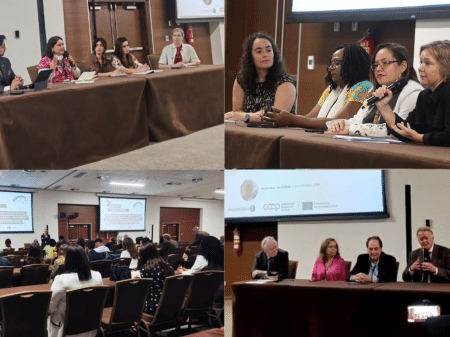
The International Cooperative Alliance Global office, ICA Africa, Cooperativas de las Américas, ICA Asia and Pacific and Cooperatives Europe officially launched the second phase of the Legal Framework Analysis (LFA) for Cooperatives during a public webinar on 25 February.
A harmonised research and analysis initiative examining the state of cooperative legislation worldwide, the LFA is implemented across all ICA Regions as part of an activity co-funded under the ICA–EU Partnership #coops4dev🌍.
The first phase of the LFA (2016-2021) produced 79 national reports and 4 regional reports; the second phase aims to further strengthen the mapping and analysis of cooperative legal environments across regions, identifying strengths, gaps and reform needs, and will be supported by researchers Melvin Khabenje, Paula Arzadu, Naveen Kumar Singh, and Paola Rosatelli.
Attendees heard several presentations, including from Alphonce Mbuya from the Department of Law at Moshi Co-operative University in Tanzania, who is Chair of the ICA-Africa Cooperative Law Committee. He said his team gathered information from 18 countries, with common issues including the problem of overregulation. The issue here is finding the right balance between cooperative autonomy and necessary oversight, he said.
Mbuya presented a case study of the African Union’s Cooperative Model Law, which has been adopted as a continental guide for co-operative legislation, and discussed colonial legacy and cooperative independence.
Also speaking were Sergio Reyes, Professor of Social Economy and Cooperativism at the University of the Republic, Uruguay (Cooperativas de las Américas) and Upali Herath, Chair of the National Institute of Cooperative Development, Sri Lanka – who gave an update on progress at ICA Asia-Pacific, where the picture is complex. On the one hand, cooperation is becoming linked with the wider concept of the social and solidarity economy, he said, and on the other, there is the colonial legacy of cooperatives following the British registrar system. This dynamic plays out against a backdrop of neoliberal economics, which is diluting cooperative systems.
“We have to see if the law is adequate enough to handle these situations,” he added.
David Hiez, Professor of Civil Law at The University of University of Luxembourg and Member of the ICA Cooperative Law Committee, said cooperative law is too often reduced to two or three rules repeated ad nauseam, neglecting the fact that it is a very complex and technical body of law. “All the reports that have been produced do indeed help to improve this understanding,” he said.
A less positive picture came from Ecuador, with Veronica Morales, from Coop Riobamba, discussing the government’s attempt last year to force the demutualisation of some financial cooperatives. This was struck down after protests from the cooperative movement, but in October, a new reform opened the possibility that co-ops could convert to banks on a voluntary basis.
She said co-op leaders are “worried about how to establish the guidelines for this” – but insisted: “True co-operatives will continue to be co-operatives.” And she thanked the ICA for its solidarity and “human support” during the dispute.
Closing remarks came from José Manuel Capitán, economist at the European Commission, and Professor Hagan Henry, Chair of the ICA Global Cooperative Law Committee.
Capitán highlighted the importance of cooperatives to agendas such as sustainable development, the social economy and decent work. He said the LFA “is really important because one of the things that cooperatives need to fulfil their mission is to have an adequate legal and regulatory environment.”
Prof Henry said knowledge of cooperative law had been diminished over the past 50 years. “This facilitated the alignment of the legal structural features of cooperatives … with those of capital-centred enterprises – disregarding that more than 1 billion cooperators around the world do not want to meet their economic, social and cultural needs in a way that they cannot identify with.”