Joint CICOPA & ICA communication for the ILO’s 114th International Labour Conference - May 2026
As the 114th International Labour Conference (ILC) begins in Geneva, the cooperative movement demands urgent action on two defining challenges of our time: the exploitation of workers in the platform economy and the persistent gender inequality in the world of work. Together, these two issues paint a picture of a world of work that is rapidly changing and one where the cooperative model has a powerful role to play.
In addition to the two items already highlighted, a significant matter on the agenda of the ILC is the discussion of the report of the Committee of Experts on the Application of Conventions and Recommendations (CEACR), including the General Survey on the Employment and Decent Work for Peace and Resilience Recommendation, 2017 (No. 205). The General Survey recognises the important role of cooperatives in advancing the implementation of Recommendation No. 205, particularly in the areas of sustainable development, employment creation, and the provision of public procurement guarantees. The report further underscores the importance of fostering an enabling environment that facilitates access to finance, thereby strengthening the capacity of cooperatives and other social and solidarity economy entities to contribute effectively to resilient, inclusive, and sustainable labour markets.
A digital economy that works for workers
The platform economy has transformed how goods and services are delivered worldwide. For millions of workers, it means precarious contracts, opaque algorithms, limited social protection, and the systematic misclassification of workers as self-employed to avoid labour obligations.
Platform cooperatives offer a proven, human-centred alternative. Owned and governed democratically by their members, these cooperatives put technology at the service of people and not the other way around. When owned by the workers, they guarantee that the development and the growth of the platform go hand in hand with decent work conditions. A growing number of delivery or driver cooperatives worldwide demonstrate that a fairer digital economy is possible.
What makes the cooperative model distinctive is not just its ethical commitments, but its structural accountability. Members own the platform, and they govern its algorithms. They decide how data is collected, used and shared. This democratic oversight is precisely what is missing from the dominant platform business models today.
Yet platform cooperatives face an uneven playing field. Large capitalistic platforms often compete by cutting corners, misclassifying workers, evading taxes and employer obligations, and using opaque algorithmic systems. Without a robust international legal framework, these practices go largely unchallenged, leaving actors that provide higher social standards – like cooperatives – at a competitive disadvantage.
The cooperative movement demands that the ILC adopt a binding Convention and a Recommendation on platform work that:
- Ensures proper worker classification,
- Guarantees adequate social protection for all platform workers,
- Mandates algorithmic transparency, and
- Ensures meaningful data ownership.
Recognising the platform cooperative model explicitly within this framework would send a powerful signal: that the international community is committed to a digital economy built on fairness, not exploitation.
Cooperatives as drivers of gender equality at work
The 114th ILC also takes up the transformative agenda for gender equality, and here too, cooperatives have a vital contribution to make.
The evidence is clear: women remain overrepresented in informal, low-paid and precarious work, and they face persistent barriers to entrepreneurship, leadership and decision-making across sectors. These are structural problems requiring structural solutions.
Cooperatives break the system. They give women ownership, fair pay, a voice, and solidarity, which allow women to not just participate in the economy, but to shape it.
The democratic governance of cooperatives also matters for gender equality beyond the workplace. When women own and lead their enterprises, they influence decisions that affect their working conditions, their schedules, their pay and ultimately, their ability to balance work with care responsibilities. This is the kind of structural change that the ILO's transformative agenda calls for.
114th ILC: A moment to act
The 114th ILC is an occasion to remind that the cooperative enterprise model offers a tested path toward a more just economy. As the ILC deliberates on platform work and gender equality, we urge member States, employers' and workers' organisations, and all ILO constituents to recognise cooperatives as essential partners in delivering on both agendas.
Decent work in the platform economy and gender equality are not separate goals. They are two sides of the same challenge: building an economy where everyone, regardless of gender, employment status or digital access, can work with dignity, security and a voice in the decisions that affect their lives.
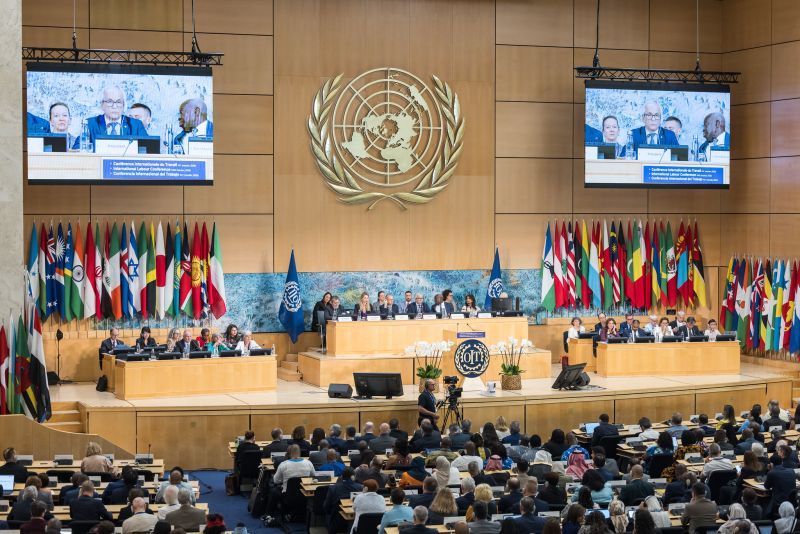
(Image: Opening of the 114th ILC (Pierre Albouy/ILO)