The Doha Political Declaration, published in November during the second World Summit on Social Development, underscored the urgency of pursuing a whole-of-government and a whole-of-society approach to eradicating poverty, promoting decent work for all, and fostering social inclusion. The declaration highlighted cooperatives as one of the models that can help to achieve change, and this was underscored at an event during the 64th Session of the Commission for Social Development at the UN’s headquarters in New York.
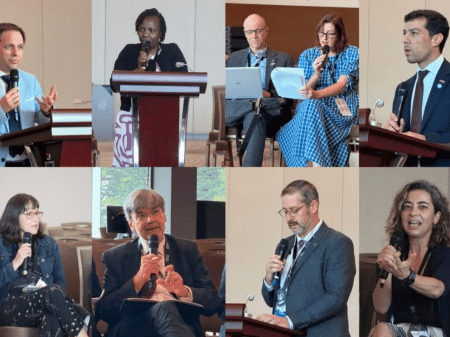
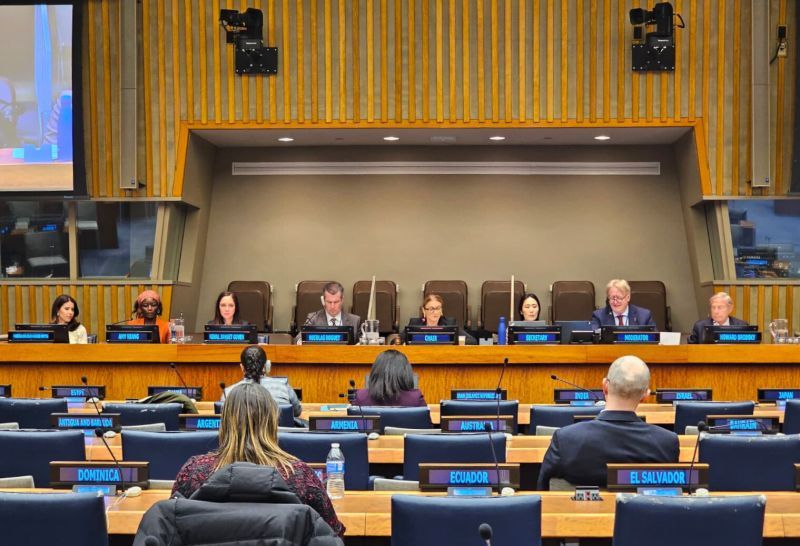
During the Multistakeholder Forum moderated by Jeroen Douglas, Director General of the International Cooperative Alliance (ICA), a panel explored financing options for development, the role of accountability within government and society, and how cooperatives can be more deliberately included within national social and economic agendas.
Participants heard practical examples of how cooperatives can build a better world through creating jobs, building inclusive societies and tackling the causes of poverty - but were told that they needed more support from governments and the wider society to scale this work up and make it a reality.
“The Doha political declaration, which we are reflecting on today, is not just another document. It's a people's plan [that] explicitly recognises what the cooperative movement has known for nearly two centuries, that social justice and poverty eradication are only achievable through a whole-of-society approach,” said Douglas.
He shared how partnerships and financial models are the enablers to scale up inclusive development. “At the ICA, we are championing a shift from traditional aid towards a model of investment in resilience,” he added, giving the example of Saccos reaching remote rural and underserved urban areas; cooperative finance mechanisms de-risking and mobilising capital and providing an ethical home for investments; and the work of Coop Exchange in setting up a network of cooperative stock exchanges and an international platform for raising capital and trading financial instruments.
A true diversification of finance is vital, said Nicolas Roguet, director of the integration and citizenship division at the Department of Social Cohesion and Solidarity in the canton of Geneva. “But it's also a major challenge, one that we need to face at all levels [because] co-financing from the private sector is now necessary in order to implement social projects at a time of dwindling public resources.”
These challenges include distrust in public policy and issues of accessibility and discrimination, but can be addressed through participation, he added. “Political and social policies need to respond to the rapid changes in current society, [but] for that to happen, it's important to involve the beneficiaries of these policies. The phrase ‘Nothing about us without us’ should apply here.”
This is the principle taken in Türkiye, said Nihal Janset Güven, explaining how her country’s approach to poverty alleviation is grounded in the principle of “leaving no one behind” and is closely aligned with the Sustainable Development Goals (SDGs).
Güven, who is Family and Social Services Expert at the Ministry of Family and Social Services of Türkiye, said: “Our mission is to empower vulnerable populations through comprehensive social protection mechanisms with a strong focus on breaking intergenerational poverty … This is achieved through an integrated service delivery model that brings together central government, local authorities, civil society and the private sector.”
There were lessons to share, she added. “Multistakeholder coordination is essential for delivering effective and sustainable results; digital systems play a crucial role in coordination and data-driven policy making; and empowering women and investing in community-based care is vital as this strengthens families, builds resilience and enhances social inclusion.”
There were lessons from Africa, too, with a research perspective on the issue presented by Amy Niang, Associate Professor of Political Science at The Africa Institute. She argued that the whole-of-government and whole-of-society approach called for in the Doha Declaration can only be effective if systems - including robust laws - are put in place that enable people to demand and defend their rights and decide how money is spent.
Prof Niang gave the example of the informal economy. “The conventional take is to want to formalise the informal economy to expand social protection. Our proposition is that the informal economy already contains sophisticated social protection systems. Policy task is not formalisation, but interface, connecting local mutualism with statutory systems without eroding local autonomy.”
Mutual associations in Ethiopia, for example, are “local funeral societies that have evolved into comprehensive social protection systems providing credit, healthcare and emergency support as well. They are not informal safety nets to be formalised by external actors. They are proto-social-protection systems rooted in principles of reciprocal obligation.”
The issue, she said, is that when social protection programs are formalised in policies that ease poverty without addressing exploitative systems like land grabbing, illegal money flows, and corporate tax avoidance, they “will face crisis when fiscal constraints bite”.
But done right, government and policy support can be helpful. Fabiola da Silva Motta shared Brazil’s experience of using cooperative finance, particularly credit unions, as a practical and effective tool for social development, poverty reduction, and job creation. Local, community-rooted financial solutions help small entrepreneurs remain in business, rural producers access timely credit, and families receive services where they live, she said, adding that Brazil's credit unions have expanded rapidly, from 7.5 million members in 2014 to over 20 million today. They are the only financial institution present in 469 municipalities.
This growth was facilitated by partnership work. “Our experience shows that cooperative finance creates pathways for cooperatives to operate, fight poverty and create jobs [but] scaling these results depends on government partnership and strong, legitimately public political representation, so that the cooperative model is treated not as an exception, but as a strategic instrument for local development.”
Howard Brodsky, founder of CCA Global, shared how the 10 richest people in the world now have more wealth than half the world’s population. Such inequality “cannot continue”, he said, stressing the importance of family businesses, cooperatives, and the need to scale both. Cooperatives, he argued, are “the great equaliser [because] they give people a stake in the game and build social capital … cooperation is not a charity. It’s an economic design.”
One major challenge today lies in knowledge and technological infrastructure, as “big tech concentrates control of data, cloud services and AI”. In response, Brodsky founded Principle Six Cooperative, “a global cooperative doing business with other cooperatives that connects cooperatives in a “secure, cooperative-owned digital environment which leverages cooperative-informed AI as an amplifier” to democratise data.
This democratisation of data was identified by Douglas in his closing reflections as one of three “golden threads on finance as a catalyst for development”, along with development rooted in dignity, not dependency, and recognition of cooperatives as core economic infrastructure.
“Cooperatives are not just partners in projects, they are the permanent infrastructure of a fair economy,” he said. “We need to stop funding temporary projects and start investing in permanent movements.”
The recording of the event can be found here: https://webtv.un.org/en/asset/k1t/k1tdzzceca