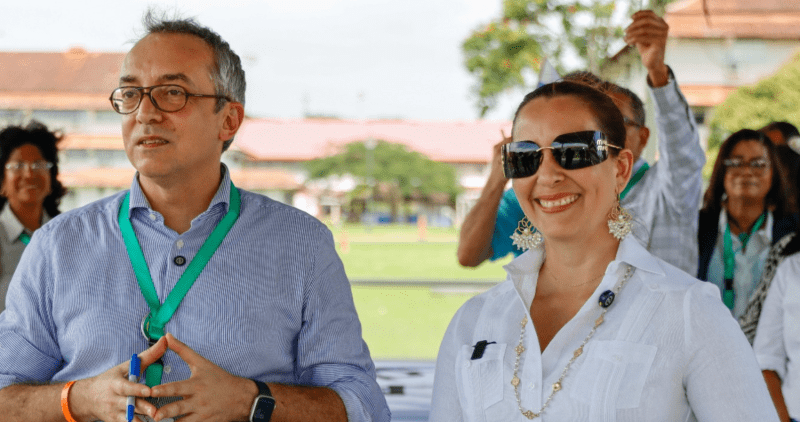
Image: Danilo Salerno (Regional Director, Cooperatives of the Americas) and Magíster Erika Vargas de González (Executive Director, IPACOOP)
The ICA and Cooperatives of the Americas global conference in Panama in September is being co-hosted by the Instituto Panameño Autónomo Cooperativo (IPACOOP) – the organisation responsible for registering, supporting, supervising, directing, and implementing the Panamanian state's cooperative policies. Here IPACOOP shares more about the country’s cooperative experience in the lead-up to ICAPanama2026.
According to the data currently available, Panama has more than 615 active cooperatives, grouping together approximately 256,000 members, with assets exceeding 2.7 billion dollars.
IPACOOP was founded in 1980 and collaborates with other cooperative organisations via an international cooperation department, channelling external financing, managing funds, identifying local needs that require support in order to link them with international counterparts, framework agreements and cooperation agreements.
Could you give us an overview of IPACOOP and its role in strengthening cooperatives in Panama?
IPACOOP has a duty both to promote and to supervise cooperatives, and it is important to understand the significance of both functions. Promotion encourages the formation of new cooperatives through education, outreach, technical assistance, and oversight, helping them become self-sustaining, effective, and efficient socioeconomic enterprises capable of improving the quality of life for their members and communities. Supervision, meanwhile, ensures that existing cooperatives maintain their growth on sound administrative and financial footing and in compliance with the law. This administration is working to strengthen both aspects.
The clear leading sector in terms of assets and financial volume nationally is multi-service cooperatives. The economic activities of the cooperative sector are diversified across savings and credit, agriculture, agro-industry, youth cooperatives, school cooperatives, transport, housing, and educators, among others.
What are the main challenges and opportunities facing the cooperative movement in the country?
Among the main challenges are regulation and compliance with both national and international standards on the prevention of money laundering, as well as the law on obligated financial entities. Panama's cooperative system is under constant pressure to modernise technologically, particularly in savings and credit services, in order to compete with traditional banking and attract new generations as part of generational renewal. The sector contributes around 4% of GDP.
Among the opportunities is the chance to position Panama on the international stage, attracting more investment to the sector and establishing the cooperative model as a driver of wellbeing, especially in communities. This also means innovating by supporting small enterprises in rural communities, particularly those led by women cooperative members or entrepreneurs, who in recent months have shown growing interest in joining the cooperative system. IPACOOP contributes to a model that enables rural inclusion and financing for agricultural sectors and microenterprises, while also building the capacity to attract social and international investment and guarantee a socioeconomic model with a social and secure focus.
What does it mean for IPACOOP and for Panama's cooperative movement to host the global cooperative community on the occasion of the 2026 ICA Global Conference?
Holding the 2026 General Assemblies and Global Conference of the ICA and Cooperatives of the Americas is a historic milestone that globally validates the presence of the cooperative system in the world, and an important driver of multisectoral interest for the whole country, with economic impact and an influx of tourists that in turn boosts hotel occupancy, gastronomy, transport, and other local logistics services. It also reinforces the country's strategy of positioning itself as a major hub, bringing together more than 1,500 cooperative members at this convention centre. It is an important political and institutional positioning, as it opens the door to governance within a board as significant as that of the ICA.
It supports IPACOOP's work in supervising and strengthening the system, putting into practice the use of innovation, inclusion through cooperativism, the promotion of youth and digitalisation, and above all showcasing those cooperative members who will be able to present their microcredit projects and socio-labour support networks built on gender equity, together with representatives from rural areas.
The conference theme is "Building bridges: cooperative contribution to a peaceful world." Why do you consider this focus relevant, and what outcomes do you hope will be achieved?
The theme strengthens cooperatives by recognising them as an important element of social inclusion and a means of achieving a more equitable distribution of wealth.
It is grounded in Panama's representation as a bridge of the world and the heart of the universe, viewing Panama as a country that actively promotes peace and is always open to dialogue. The Bridge of the Americas unites cooperativism across cultures and highlights that people stand above any conflict; it is a symbol of Panamanian identity that spans the Panama Canal and emphasizes that we connect North America with South America. In this way we foster collaboration among the different cooperatives of the region, creating a space for connectivity to bring together more than 1,500 cooperative delegates from around the world.
How did you mark the International Year of Cooperatives 2025, and how do you see cooperatives in Panama continuing to contribute to "building a better world"?
This event was considered one of the most important in the region, raising the profile of Panama and its cooperative system.
As part of the agenda, the Panamanian Autonomous Cooperative Institute raised the international flag of cooperativism in a ceremony that brought together dozens of cooperative members, associates, and managers of the country's cooperatives around the institution, along with government authorities and youth cooperatives, which had a strong showing, including a parade with schools known for their Youth Cooperatives. As part of the same event, International Cooperatives Day was honoured in the province of Veraguas, with exhibitions and processions through the province's main streets, bringing together thousands of cooperative members in a cooperative gathering.
A regional event was also held jointly with ICA and the Professionals' Cooperative under the theme "Economy and Society of Care," which brought together more than 400 representatives at the City of Knowledge. This major regional event achieved significant social impact, particularly among the delegates and national and international authorities who took part, and notably received extensive media coverage, with features in newspapers, radio, television, magazines and alternative media.
Building a better world through cooperatives is achieved by reaffirming the contribution of cooperative enterprises to social justice, inclusion, solidarity, and economic, social and environmental development, by promoting principles and values, democratising the economy, and placing human worth above any other interest.