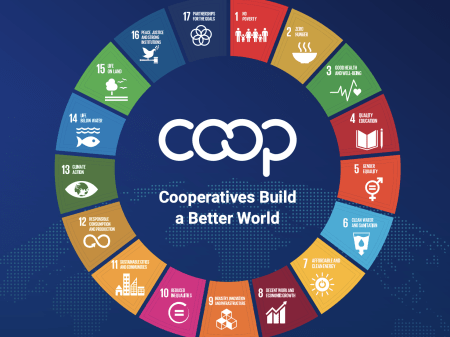
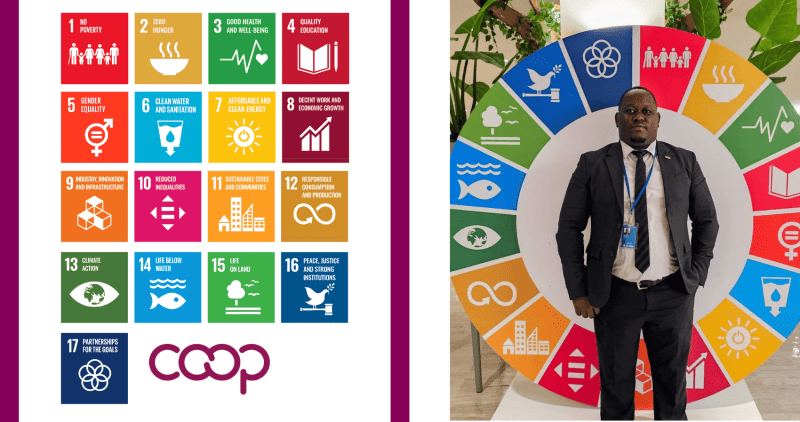
Over the last 18 months, the ICA and the UN Committee for the Promotion and Advancement of Cooperatives (COPAC) have been publishing a series of policy briefs to show how cooperatives are essential partners in helping the world to achieve the United Nations’ 17 Sustainable Development Goals.
The SDGs were adopted in 2015 with the ultimate aims of taking steps to peace and prosperity for people and the planet, tackling climate change, and working to preserve oceans and forests by 2030, as part of the 2030 Agenda for Sustainable Development.
A decade into the agenda, the UN also proclaimed the second International Year of Cooperatives (IYC2025) – and the idea for the policy briefs, says ICA Director of Policy, Joseph Njuguna, came from two converging opportunities: the IYC2025 and the “growing recognition that cooperatives are essential partners in achieving the SDGs”.
“There is extensive evidence of cooperatives' impact around the world, but it is often scattered across sectors, regions and individual studies,” he says. “We wanted to bring that evidence together in a way that speaks directly to policymakers, governments, UN agencies and development practitioners.
“Working with COPAC, we saw an opportunity not only to celebrate the International Year of Cooperatives but also to leave behind a lasting policy legacy. Rather than simply highlighting success stories, we wanted to demonstrate, SDG by SDG, how the cooperative model contributes to sustainable development and why it deserves greater recognition in public policy and development strategies.”
These briefs, which address each of the 17 SDGs, have now been brought together on one webpage (2025.coop/sdgs). They are, says Njuguna, “both a celebration of what cooperatives have achieved and a practical advocacy tool to help accelerate implementation of the 2030 Agenda during its final stretch, with only four years remaining to achieve the Goals.”
The briefs were produced collaboratively by COPAC members, ICA regional offices (ICA Africa, Cooperativas de las Américas, ICA Asia and Pacific, and Cooperatives Europe), sectoral organisations and thematic specialists.
“For each SDG, we worked closely with the COPAC Coordinator, ICA regional colleagues and sectoral experts who understood both the technical dimensions of the Goal and the practical realities of cooperatives on the ground,” Njuguna explains. “The drafting process involved extensive research, several rounds of peer review and consultations across regions to ensure both technical rigour and geographical balance.”
For him, one of the most rewarding parts of the process was selecting the case studies: “Together with the ICA regional offices, we deliberately sought examples from every region of the world and from a wide range of cooperative sectors. We weren't simply looking for inspiring stories; we wanted examples that demonstrated measurable impact, innovation and practical lessons that could be replicated elsewhere.”
The result is a collection that reflects the diversity of the global cooperative movement while demonstrating that, regardless of geography or sector, cooperatives consistently contribute to sustainable development through their shared values and principles.
Njuguna adds that one of the biggest lessons for the team was that “there isn't a single SDG to which cooperatives do not make a meaningful contribution”.
While some connections are immediately obvious (such as SDG 1 and 2 on poverty eradication and food security or SDG 8 on decent work and economic growth), what surprised him most “was the strength of the evidence for Goals that are not traditionally associated with cooperatives, such as SDG 16 on peace, justice and strong institutions, or SDG 9 on industry, innovation and infrastructure, and SDG 11 on sustainable cities and communities”.
He adds: “The process also reinforced something we've long believed within the cooperative movement: cooperatives rarely contribute to just one SDG at a time. Because they combine economic, social and environmental objectives within a democratic business model, their impact naturally cuts across multiple Goals simultaneously.
“Perhaps the most important insight was that what distinguishes cooperatives isn't simply what they do, it's how they do it. Democratic governance, participation, shared ownership and concern for community are not only cooperative principles; they are also powerful enablers of sustainable development.”
While the briefs were designed first and foremost as practical policy tools, the team hopes governments will use them when preparing Voluntary National Reviews, designing national development strategies and reviewing cooperative legislation. They also hope UN agencies, development partners, researchers and civil society organisations will use them as evidence of what works and as a basis for stronger partnerships with the cooperative movement.
The briefs are already being shared widely through the International Year of Cooperatives website, COPAC and the ICA's global network, and the hope is that they will continue supporting advocacy well beyond 2025.
“Equally importantly, we hope ICA members and cooperatives around the world will use them in their own advocacy efforts,” says Njuguna.
“The briefs can be adapted to national and local contexts, helping cooperatives engage with governments and other stakeholders while demonstrating that their contribution to sustainable development is recognised at the international level. They provide strong evidence that cooperatives are not simply beneficiaries of public policy but key development partners, and therefore deserve a seat at the table when national development strategies, SDG implementation plans and policy consultations are being designed.”
While each policy brief stands on its own, together they tell a much bigger story: that cooperatives contribute to every one of the SDGs. There are now plans to publish the entire series as a flagship publication, to be launched during the ICA Global Conference in Panama in September 2026, which will serve as a lasting reference on cooperatives and sustainable development and will support global advocacy efforts in the lead-up to the UN SDG Summit in September 2027, where world leaders will take stock of progress on the 2030 Agenda and begin shaping the post-2030 development framework.
Although the series is completed, the briefs are not the end of the journey, but mark the beginning of a new phase, says Njuguna, adding that the challenge now is to translate this evidence into policy action.
“That means ensuring cooperatives are recognised as strategic implementation partners in national SDG strategies, strengthening enabling legal and policy frameworks, improving cooperative data and statistics, and investing in cooperative development as part of broader economic and social policy.”
As we enter the final years of the 2030 Agenda and look ahead to the SDG Summit in 2027, where the international community will begin shaping the post-2030 development agenda, the cooperative movement has an important opportunity to move beyond demonstrating its impact and become more systematically integrated into implementation, policy dialogue and decision-making processes.
“Ultimately,” adds Njuguna, “our ambition is simple: for cooperatives to be recognised not as an alternative business model operating on the margins, but as one of the world's most proven, democratic and scalable models for delivering inclusive, resilient and sustainable development.
“The evidence is there. The challenge now is to translate that evidence into stronger policies, greater investment and more meaningful partnerships so that cooperatives are recognised as strategic partners in delivering the Sustainable Development Goals, and beyond 2030”.
These policy briefs have been produced under the ICA-EU Partnership (2024–2028), also known as #coops4dev🌍, a five-year international cooperative development programme co-funded by the European Union, aimed at strengthening the ICA network and positioning cooperatives as key actors in international development.
Read all of the SDG Policy Briefs at 2025.coop/sdgs.